



Benefits include higher transmission density, reduced cable volume, optimized space utilization, lower infrastructure overhead, and improved scalability.
Yes. Multicore fiber is being developed and tested to support high-capacity optical transmission, including 800G and beyond, as network demands continue to grow.
AI workloads generate massive volumes of data traffic between GPUs, servers, and storage systems. Multicore fiber increases transmission capacity while reducing cabling complexity and infrastructure requirements.
Although fiber is very small, it can transmit a virtually unlimited amount of information.
Once it is installed, future speed upgrades take place at the ends of the network, meaning the building should not need to be rewired again. The fiber technology will support future upgrades to higher speeds for decades.
Surveys continually find that access to high speed internet is an important MDU amenity and fiber is the most future-proof way to do that.
InvisiLight Solutions have connected over 1 million subscribers to fiber in homes and apartments – and this proven technology is ideal to bring fiber to the MDU unit.
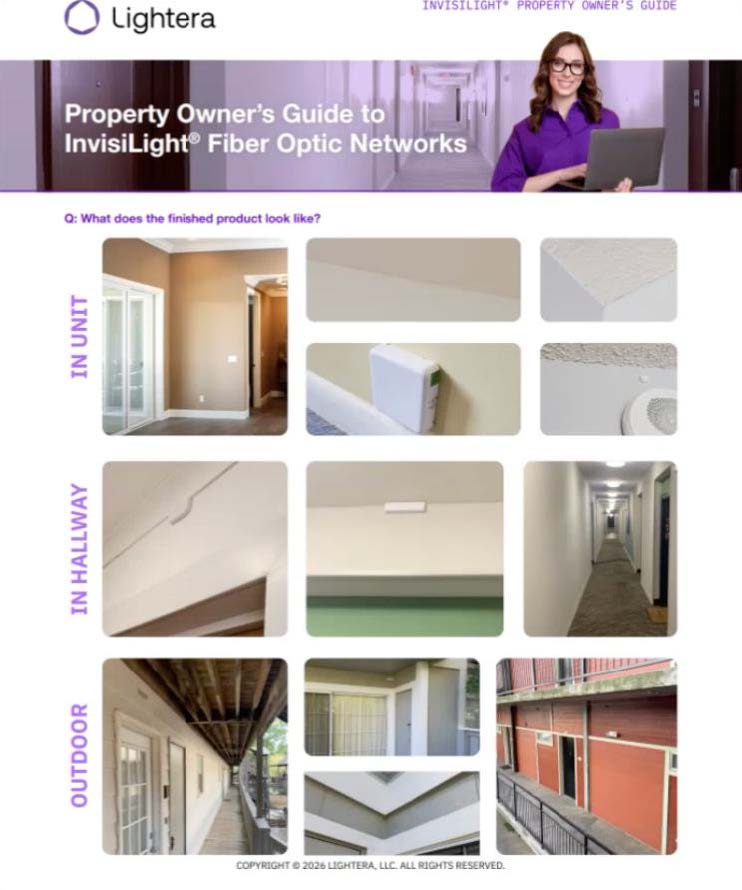
The installation process is clean and relatively quiet. The process is fast, with limited disruption to residents. Residents have full access to the building and unit during the installation process.
Crews place a small “Point of Entry” module above each door.
They then run a small cord down the hallway or outside the units, dropping a fiber off at each unit.
A fiber is then run from inside each unit to connect the fiber in the hallway.
The process takes roughly 2–3 hours for a 12 unit hallway, and 30–45 minutes inside the unit.
The fiber is a special type designed for use in homes, apartments, and buildings with many bends. It is compliant with the ITU G.657.B3 Recommendation, but is specified to half the bend radius (less bend sensitive). It’s much less bend sensitive than typical ITU G.652.D fibers that are normally used in the outside plant.
Millions of units have already been connected for up to approximately 15 years with this fiber type.
No, product installation is simple. Use the adhesive contained in the syringe supplied in the kit. Additional installation accessories are included. If the cord needs to pass through a wall, a drill will be needed.
It can be installed on almost all common indoor wall surfaces such as brick, wood, drywall, plaster, wallpaper, etc.
Yes.
No, the sensors do not have a technological dependency on optical boxes, meaning they can be used in any box. Therefore, it is not necessary to use specific optical boxes to take advantage of the sensors.
Yes, it is possible to integrate with EyON. The system has APIs that allow for sending and receiving information according to the needs of the integrations.
No, the EyON Telecom app does not require a VPN connection or a dedicated server to be used. It is fully developed on the AWS cloud and can be accessed from anywhere. Additionally, using AWS services ensures high availability and scalability of the solution.
The EyON Telecom app can be downloaded from both the Android and iOS app stores. It was developed with an “offline-first” approach for certain applications, allowing some tasks to be performed even without internet access. The app stores data locally on the mobile device, and once an internet connection is available, the data is automatically synced to the cloud. This enables technicians to continue working and collecting information even in areas with limited or no connectivity. When the internet connection is restored, all information is updated in the cloud, ensuring that the support team and other stakeholders have access to the latest data.
Under normal operating conditions, these batteries have a lifespan of 5 years and need to be replaced when their charge is depleted. This is because they use thionyl chloride lithium batteries, which are ideal for applications that require long-lasting performance, such as aerospace and medical fields.
The LoRa service can be contracted in two different ways: private or public. If the client chooses the private service, it is necessary to build a private network. The public option, on the other hand, is facilitated by Lightera, which already has an available LoRa provider.
Marketing efforts and revenue allocation will continue as usual, with local sales teams offering the best solutions from Lightera’s portfolio in a transparent and professional manner.
Nenhum. Estamos trabalhando com os funcionários do governo para assegurar que as alterações apropriadas sejam atualizadas.
No. Fiber optics are not heated by the light they carry, and therefore do not emit heat or cause any other type of heating effect.
The number of fibers in a fiber optic cable is called “fiber count”. Fiber count will vary depending on the application. Today, it can range from one fiber up to about 7,000 fibers. Cable manufacturers are continually finding ways to increase fiber count to accommodate the growing demand for bandwidth.
The number of components making up a fiber optic cable will vary depending on the end-use. Some designs are simple when applications are light-duty. The harsher the environment the fiber optic cable will be exposed to, the more complex the cable structure. In simple terms, a fiber optic cable has 5 basic components:
The core of the optical fiber which may vary in size between 8 microns and 2000 microns.
The cladding which is the layer that surrounds the core. This is usually silica and can sometimes be plastic.
The coating. This is the outer layer of the optical fiber. It is extruded and may be colored for easy identification in multi-fiber cables.
A strength member which will provide additional protection from breakage / signal deterioration.
An outer jacket to provide a final layer of protection for the optical fiber inside.
Fiber optic cables come in various constructions depending on the end-use. They range anywhere from a simplex construction (one strand of fiber with an outer PVC or other plastic) to cables consisting of hundreds of fibers grouped in tubes and stranded around a central strength member with a plastic outer jacket. Multimode fibers are usually constructed in simplex, duplex, zipcord designs and may be either tight-buffer or loose-tube configurations that incorporate anywhere from 1 to several 10’s of fibers. Single-mode fiber optic cable constructions are more complex and may incorporate hundreds of optical fibers.
The cable construction for either type of optical fiber cable is there to provide protection to the optical fiber inside: Protection from excessive bending, crushing, strenuous pulling, etc. The outer jacket of the cable may be made from a variety of plastic materials ranging from PVC to Polyurethane to Polyethylene to name a few.
There are two main categories of optical fibers: single-mode and multimode. “Mode” refers to a ray of light traveling down the fiber. Multimode (multiple rays of light) fiber is further classified as either graded-index or step-index. The index profile describes the way the multiple rays of light travel down the fiber. In a multimode graded-index fiber, the light travels in a sinusoidal pattern down the length of the fiber to arrive at the end pretty much all at the same time. This type of multimode fiber is used in a short distance, data communications networks such as within a building or between buildings in an office park. In a multimode step-index fiber, the multiple rays of light travel down the fiber in a haphazard manner with each ray arriving at the end at different times. These types of fibers are also used in short-distance, harsh industrial and aerospace environments to provide secure communications. Larger core multimode step-index fibers may be used to transmit laser energy in places like the operating room, to clean graffiti from historical monuments, and to direct energy in military defense systems. Multimode fibers vary in core size from 50 to 2000 microns. They may be made from pure silica quartz, plastic, or other materials.
Fiber optic cables are made up of glass fibers that transmit light signals over short and long distances. They are used in industrial communications settings as well as telecommunications networks for high-speed data transmission. They are also used to transmit high-power laser energy in such applications as medical lasers for surgery and military laser defense systems. In communications applications, optical fibers are replacing copper wire because they can carry much more information than copper does and at much higher speeds.
A fiber optic cable contains anywhere from one to several hundred optical fibers within a plastic casing. Fiber optic cable (or optical fiber cable) transfers data signals in the form of light and travel anywhere from a few feet to hundreds of miles significantly faster than signals in traditional copper cables.
No. To connect the OLT’s optical ports to one ONU, becomes necessary to review the ONU’s optical sensibility and then through devices and gadgets as splitters and connectors, attenuate the power of the issued signal by the OLT. Otherwise, if they’re directly connected it’s possible to damage the devices.
Yes, it´s possible to access the equipment through the “NETWORK” interface with the following default IP: 192.168.20.1/24.
No, the OLT only have access through CLI (Command Line Interface). This access could be through Console (Interface Serial), Telnet or SSH.
